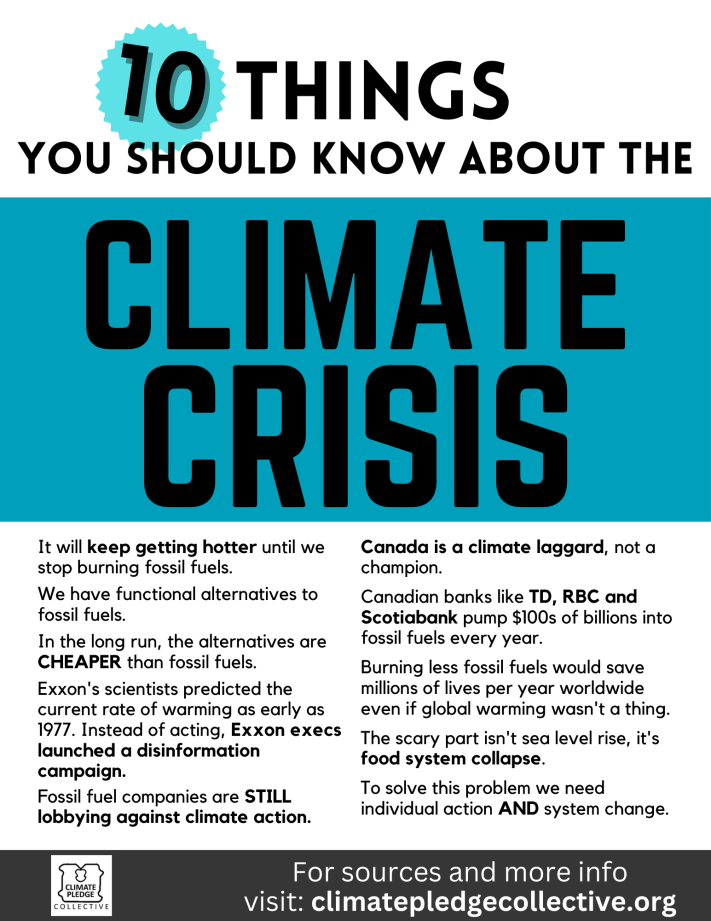
Did you see our poster out in the wild? This blog post provides more info, context and links to additional sources for the 10 Things You Should Know about the Climate Crisis.
We’ve also got blogposts about our other posters: 10 Great Ways to Ignore the Climate Crisis and 10 Things You Can Do about the Climate Crisis.
1. It will keep getting hotter until we stop burning fossil fuels.
Our climate is determined by the total amount of CO2 in the atmosphere. Natural cycles (like plants growing) will remove a certain amount of CO2 each year but any excess that is added will stay there for 300-1000 years (source). This means that the total amount of heat-trapping carbon dioxide in our atmosphere will just keep going up and up. Reducing our emissions will slow this process, but it won’t reduce temperatures until the amount of carbon dioxide we add is LESS than the planet can naturally absorb. This is why we can’t ‘compromise’ and keep using a ‘moderate’ amount of fossil fuels. You can’t compromise with physics.
2. We have functional alternatives to fossil fuels.
No one is asking you to stop eating our heating your house. We’re asking you — and the rest of society — to change the way we do things.
We can make electricity with wind and solar power and store it in batteries for when the sun isn’t shining and the wind isn’t blowing. We can also use nuclear power to supplement renewables — but nuclear power plants are getting more and more expensive while renewables are getting cheaper, so they should only be used when other alternatives are impractical.
We need to drive less and walk, bike and take public transit more. Those who really need to drive should drive EVs.
New technologies are coming online that will even allow us to decarbonize industries like steel and cement making that were considered impossible to decarbonize only a few years ago.
Although short-haul flights can now be completed by electric planes, there is no commercially viable replacement for frequent long-distance flights. Unfortunately, we may have to take our vacations closer to home, at least until zeppelins catch on again.
3. In the long run, the alternatives are CHEAPER than fossil fuels.
Although EVs are more expensive to buy, they are cheaper in the long-run because they are extremely cheap to keep charged and the maintenance costs are substantially lower. If you add in the tax rebates that are available in many jurisdictions they are heads and tails cheaper. While natural gas has been the cheapest way to heat your home for many years, we’re finally reaching a tipping point where an air-source heat pump – though expensive to install — will pay for itself and even start making you money down the road. Using this calculator, I discovered that we would save $4000 over 15 years by installing an air-source heat pump instead of a new gas furnace – even though the heat pump is much more expensive to install.
Why is this the case? We like to think of printers and ink cartridges. Printer manufacturers take a loss on printers because they know they’ll make it up on ink cartridges. Fossil fuels offer the same opportunity to lock customers into a life-time payment plan.
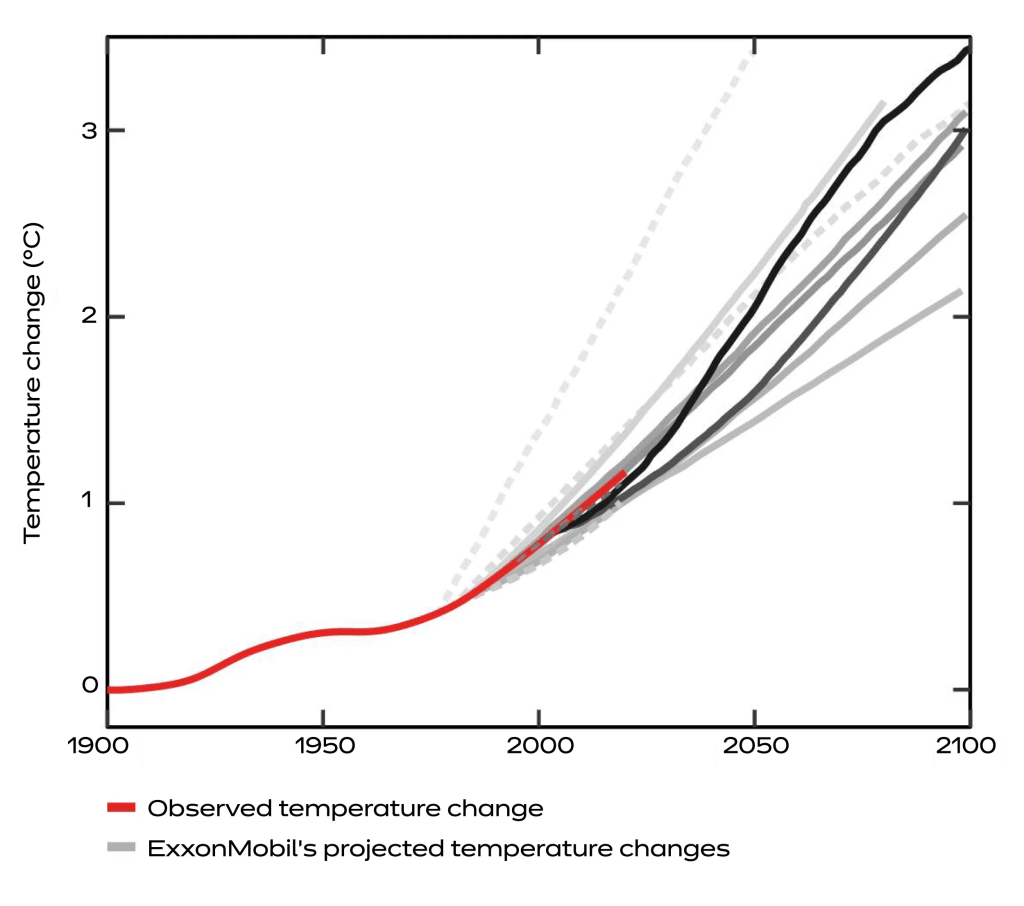
4. Exxon’s scientists predicted the current rate of warming as early as 1977. Instead of acting, Exxon execs launched a disinformation campaign.
Exxon has been studying climate change for decades. When they realized fossil fuels were a threat to the planet, they buried the truth because saving the planet might cut into their profit margins. Exxon has funded climate disinformation for decades with the explicit goal of preventing a consensus from forming in the scientific community. To provide world governments from taking appropriate action, they didn’t need to disprove the connection between fossil fuels and climate change — they only need to make it uncertain.
5. Fossil fuel companies are STILL lobbying against climate action.
This isn’t some bit of unfortunate history either. Right now fossil fuel companies are paying lobbyists to weaken climate policies around the world. This twitterbot tracks meetings between fossil fuel lobbyists and Canadian government officials. When climate activists call out fossil fuel companies, they aren’t suggesting they should be shut down over night — we need oil and gas for at least a decade — but they need to be reined so they can’t use their profits to misinform the public and manipulate our governments!
6. Canada is a climate laggard, not a champion.
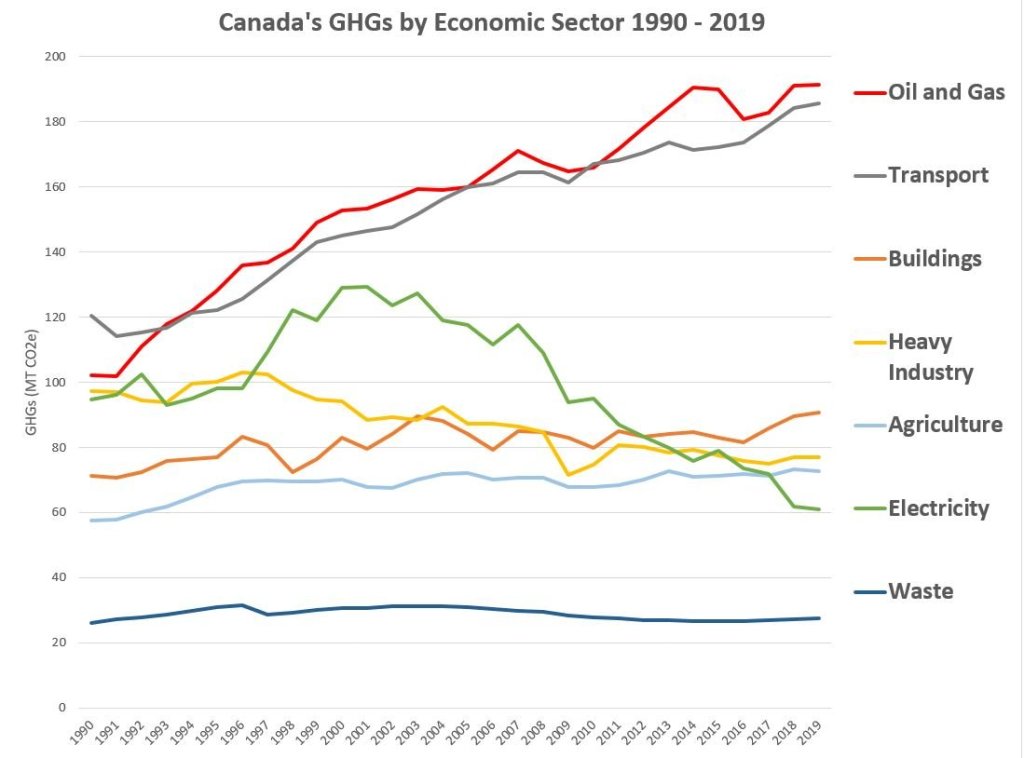
Not only are Canada’s per capita emissions among the highest in the entire world, our emissions in most sectors continue to sky-rocket while other countries are rapidly turning the corner.
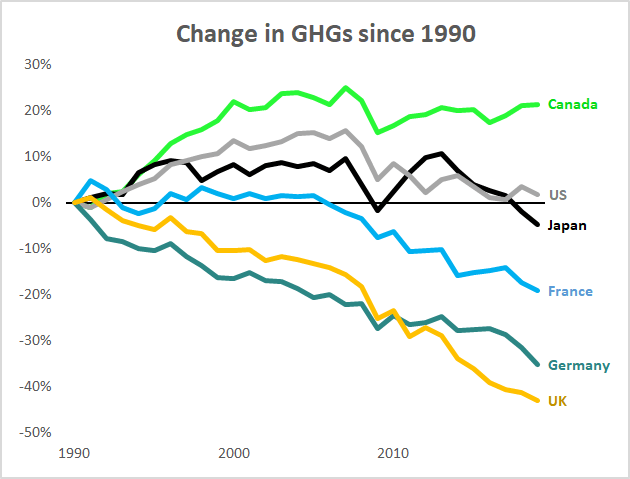
Why are Canadian emissions failing to fall? Because a major decline in our electricity sector caused by the closure of coal power plants in Ontario and Alberta has hidden a drastic increase in emissions from oil and gas (tar sands) and transportation (SUVs).
7. Canadian banks like TD, RBC and Scotiabank pump $100s of billions into fossil fuels every year.
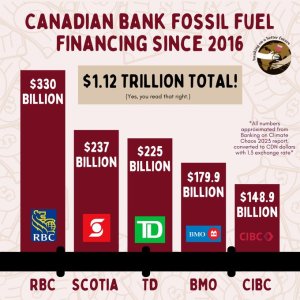
This graphic by the super-awesome Banking on a Better Future group of climate activists is based on data from the annual Banking on Climate Chaos report. We wrote up our thoughts on the most recent report here.
8. Burning less fossil fuels would save millions of lives per year worldwide even if global warming wasn’t a thing.
Air pollutions causes millions of pre-mature deaths each year and the leading cause of air pollution is burning fossil fuels — both in vehicles for transportation and for power generation, especially in coal plants.
9. The scary part isn’t sea level rise, it’s food system collapse.
For whatever reason, the stereotypical climate disaster is sea-level rise. Yes, the ocean’s are rising. Yes, it’s a problem. But it’s a slow-moving problem that we can adapt to. Sudden collapse of global food systems is not something you can move away from and experts are increasingly concerned about the impact that climate change is having on fisheries and agriculture.
10. To solve this problem we need individual action AND system change.
Some people will tell you ‘Governments should stay out of it. If we want to stop the climate crisis all we have to do is stop driving and flying. We’re the ones destroying the planet.’ Others will say, “It doesn’t matter a bit what my personal carbon footprint is, 100 companies are responsible for 71% of emissions.”
Both types of people are wrong.
Systems constrain our behaviour as individuals. But those same systems are the product of billions of bits of personal behaviour. A government incentive can make e-bikes more affordable and shift a million personal choices. But being an early adopter of a new e-bike can drive down the price of future models and encourage others who hear you talking about how great it is to also by the same bike, driving prices down further.
There is no single-solution to the climate crisis: it will take different people building different solutions at different scales. We need to make changes in our individual lives — eating less meat and dairy, driving less, flying less — but we also need to organize collective action to support those changes — bike lanes, better transit, renewable energy, new (or older) agricultural practices, macro-economic policies, regulations, divestment and new relationships with each other and our planet. Trying to make individual changes is also the best way to identify structural barriers that are preventing people from doing the bottom-line.
The bottom-line is that this is a crisis. Why argue about whether we need individual change OR system change, a carbon tax OR a ban on new fossil fuel exploration when the answer is almost always BOTH/AND.
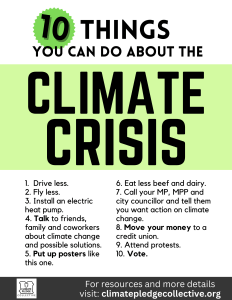
If you’re ready to take action go here.

 Climate Pledge Collective